Define the Reader Task
We begin with the exact job a reader needs to finish and reduce it to one sentence. A draft that does not answer that sentence does not go live.

See how BillHorizon Fieldbook develops, checks, and updates practical payment-record guides.
BillHorizon Fieldbook is written for readers who track household bills, subscription renewals and monthly budgets in everyday tools. Every article is built so that you can follow it from the first line to the last step and finish with a correct, repeatable result on your own file.
Each guide starts with a task our readers actually face: lining a due date up with a statement cycle, rebuilding a projected balance after a price change, or tidying a category that has quietly drifted. We complete that task from scratch on a clean file before we write a single sentence about it.
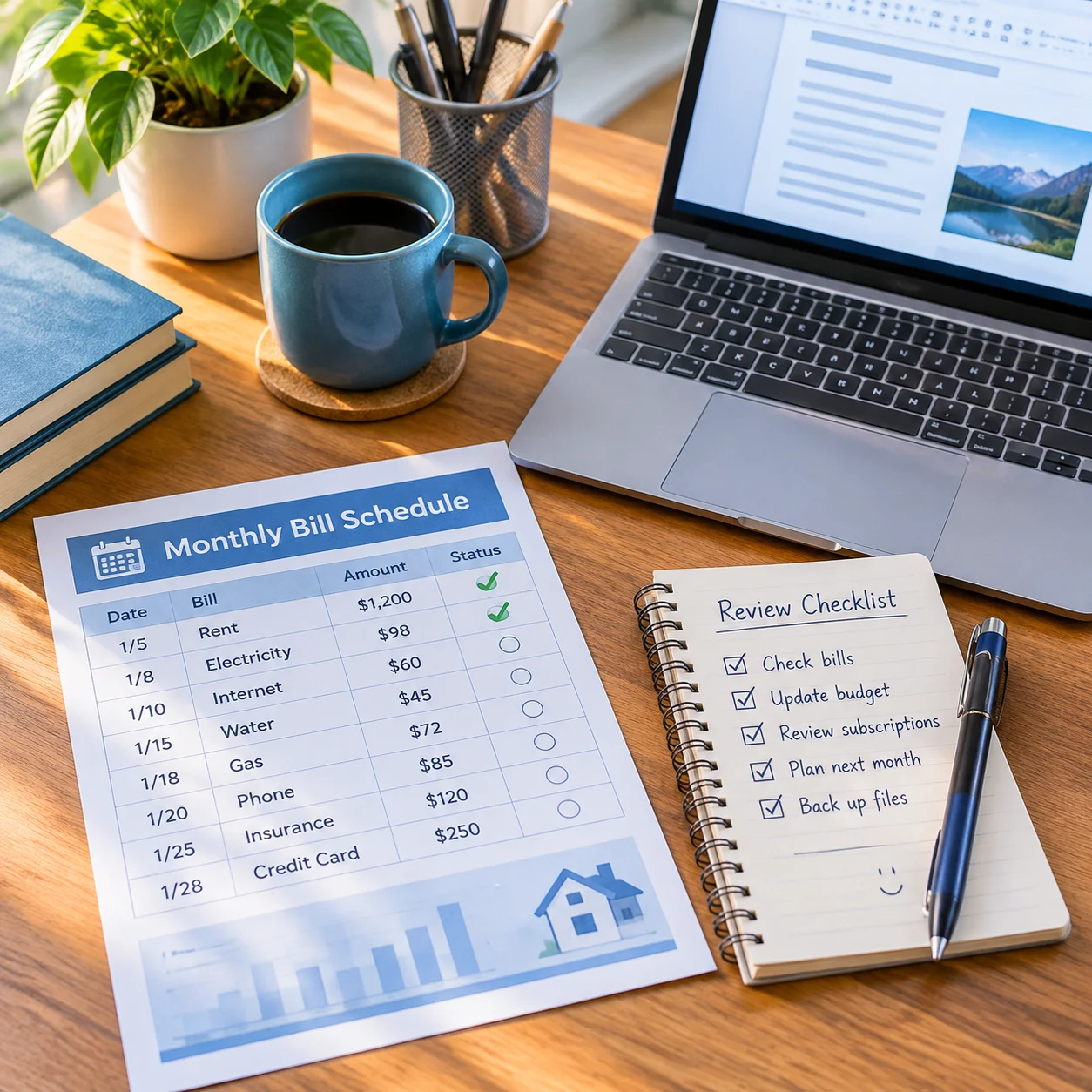
We begin with the exact job a reader needs to finish and reduce it to one sentence. A draft that does not answer that sentence does not go live.
A writer reproduces the whole workflow on a fresh sample file, so no step depends on a hidden setting, an old category or a reminder that was already there.
A second reviewer recalculates every amount, date and formula shown in the walkthrough. When a total or a due date does not match, the guide returns to the writer.
Every article names the version it was tested on and carries a review date. When a screen or a setting changes, we retest the affected steps and note the update.
Guides are written by the editors who maintain this site. Each writer works from their own sample file and is the person who completes the walkthrough, so the name on an article matches the person who tested it.
The writer completes the task on a clean file and records the starting point, each step and the finished result. A second reviewer then repeats the same steps independently and recalculates every number before the article is scheduled.
We open the guide, reproduce the reported step and check whether the text or the software has changed. Confirmed errors are fixed within a few working days and the article shows a new review date. Reports reach us through the contact page.
No. A walkthrough never replaces a step you can complete in the software with a paid tool, and no partner can request a change to a step. If an article ever carries a partner link, it is labelled above the relevant sentence.
Every guide is re-read at least once a year and again whenever the software changes a menu, a label or a default. The review date shown on an article is the date of the last real check, not a routine edit.
Open any walkthrough, follow one step on a copy of your own file and see whether the result matches what the article promises. If something does not add up, write to us and we will look at it with the same checklist.